

Choosing the Right City to Study in China: Beijing vs Shanghai vs Hangzhou
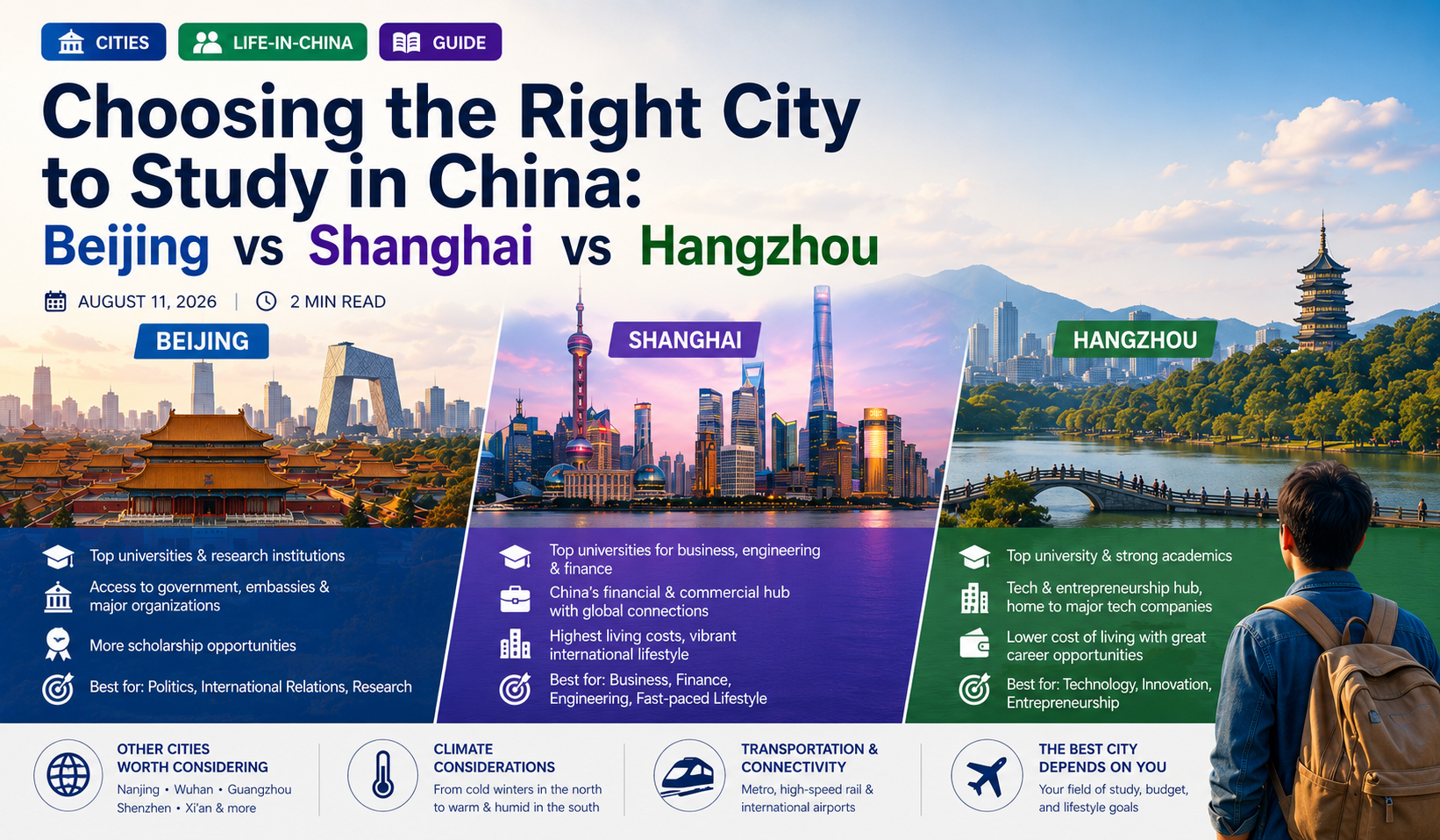
Choosing where to study in China is almost as important as choosing what to study. Each city offers a different balance of cost, career opportunity, and lifestyle. Here's how three of the most popular student cities compare.
Beijing
As China's capital, Beijing is home to some of the country's top universities, including Tsinghua and Peking University. It offers unmatched access to government institutions, embassies, and major corporate headquarters, making it ideal for students interested in politics, international relations, or research. Living costs are higher than average, but so is the density of scholarship opportunities.
Shanghai
Shanghai is China's financial and commercial hub, attracting the largest international business community in the country. Universities like Fudan and Shanghai Jiao Tong University are known for strong business, engineering, and finance programs. The city has an energetic, cosmopolitan feel with a large expatriate population, though rent and daily expenses tend to be the highest in China.
Hangzhou
Hangzhou, home to Zhejiang University and the headquarters of major tech companies, has become a rising hub for students interested in technology and entrepreneurship. It offers a noticeably lower cost of living than Beijing or Shanghai while still providing strong academic and career opportunities, along with a much greener, more relaxed environment.
Which City Is Right for You?
- Choose Beijing if you want access to top-ranked universities and political or research institutions.
- Choose Shanghai if you're focused on business, finance, or a fast-paced international lifestyle.
- Choose Hangzhou if you want strong academics and tech opportunities with a lower cost of living.
There's no single right answer — the best city depends on your field of study, budget, and the kind of environment you want to live in for the next several years.
Other Cities Worth Considering
- Nanjing — a historic city with strong universities and a much calmer pace than Shanghai, at a fraction of the cost.
- Wuhan — one of China's largest student cities, home to Wuhan University and dozens of other institutions, with very affordable living costs.
- Guangzhou and Shenzhen — southern China's business and technology corridor, close to Hong Kong, with a warmer climate and strong industry connections.
- Xi'an — a major hub for engineering and history-focused programs, known for its lower cost of living and rich cultural heritage.
Climate Considerations
China's climate varies dramatically by region. Northern cities like Beijing and Harbin have cold, dry winters and hot summers, while southern cities like Guangzhou and Shenzhen stay warm and humid year-round. Central cities like Wuhan and Nanjing sit in between, with distinct seasons. If climate matters to your day-to-day comfort, factor it into your decision alongside academics and cost.
Transportation and Connectivity
All of the cities mentioned here have extensive metro systems, high-speed rail connections, and international airports, making it easy to travel around China during breaks. Beijing and Shanghai have the most direct international flight connections, which can matter if you're planning to travel home frequently during holidays.